
For millennia, the architecture of human civilization has rested on an implicit and unbreakable pact: to have the right to a roof over one’s head, a plate of food, and a dignified existence, the individual had to rent out their time and physical or mental effort. Work was not just a means of production; it was the ticket to survival and the moral axis around which our identity revolved. However, for the first time in modern economic history, the foundations of that pact are about to break. And not because of a scarcity crisis, but because of a tsunami of technological abundance that will force us to redefine what it actually means to earn a living.
We stand on the threshold of a historic collision between two unstoppable forces: advanced artificial intelligence and autonomous robotics. While cutting‑edge algorithms absorb cognitive work—from accounting and legal analysis to programming and administrative management—a new breed of machines equipped with fine motor skills is beginning to be deployed in factories, farms, logistics warehouses, and supply chains.
The diagnosis is as cold as it is evident: a colossal proportion of the jobs that today sustain the middle class will evaporate. Not because companies are evil, but because the law of economic efficiency is relentless. No board of directors will maintain costly labor structures when an ecosystem of digital agents and robotic arms can operate twenty‑four hours a day without fatigue, without sick leave, and at a fraction of current cost.
In this scenario, the traditional discourse usually splits between apocalyptic catastrophism and naive denial. Yet there is a third path, backed by the pure logic of technological deflation, that draws a radically different future: the birth of a society of optional work.
To understand how we will get there, we must look at what happens to the price of things when the most expensive factor in any business equation disappears: labor. When inexhaustible solar energy powers robots that till the soil, harvest food, process it, and transport it in autonomous vehicles, the real cost of producing a grocery basket collapses toward zero. When modular robotic construction and 3D printing are applied to building, raising a decent, efficient home ceases to be a thirty‑year financial odyssey. And when education, preliminary medical diagnosis, and entertainment are delivered through automated digital infrastructures, essential services stop being scarce goods.
In an economy where machinery produces goods and services at a ridiculously low marginal cost, but millions of citizens have been displaced from the traditional labor market, capitalism faces an elemental paradox: robots produce perfectly, but robots do not buy. If the population has no income because its jobs have been automated, consumption stalls and the system collapses under its own efficiency.
This is where Universal Basic Income stops being a salon‑room ideological banner and becomes a mathematical necessity for market survival. We are not talking about a generous charitable subsidy that strangles states, but about a basic economic allocation that, combined with the drastic cheapening of housing, food, energy, and digital leisure, will be more than enough to guarantee a full, calm, and dignified life without the need to clock in at an office or factory.
In that horizon, not as distant as many think, the word “work” will finally shed its etymological root tied to torture (tripalium) and become a genuinely free choice.
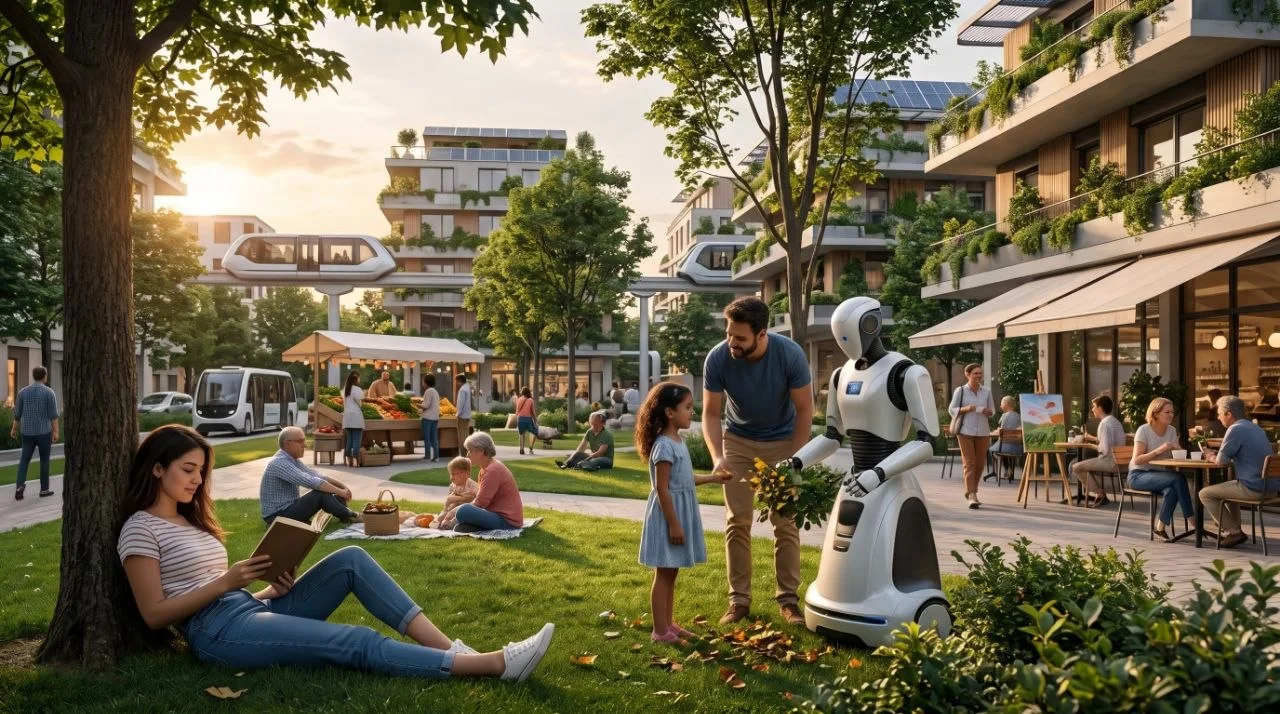
Anyone who decides to settle for a serene existence, with material needs covered, dedicating their days to family, sport, reading, caring for their environment, or simple contemplation, will be able to do so without social stigma or the anxiety of not making ends meet. Subsistence will be detached from the paycheck.
Does this mean the end of human effort and the death of excellence? Quite the opposite. It means its purification. In a society where no one works out of fear of hunger or eviction, work will be driven solely by two noble engines: vocational devotion and personal ambition.
The researcher passionate about deciphering the mysteries of biology will work; the craftsman, chef, or artist who enjoys offering an authentic human touch that no machine can emulate will work; and, of course, the ambitious entrepreneur who is not satisfied with the basic standard and wishes to create empires, take risks, and access luxury goods, exclusive properties, or extraordinary experiences will work. The reward for merit and effort will continue to exist for those who wish to climb higher, but the ground will be guaranteed for everyone.
The true challenge of our generation is not to halt machines to save repetitive jobs that, deep down, no one will miss. Our challenge is to manage the transition with fiscal intelligence and political maturity so that the dividends of this unprecedented productivity fund the greatest leap of freedom for our species. Moving from working out of obligation to working out of devotion is not the end of the economy; it is the true beginning of civilization.