
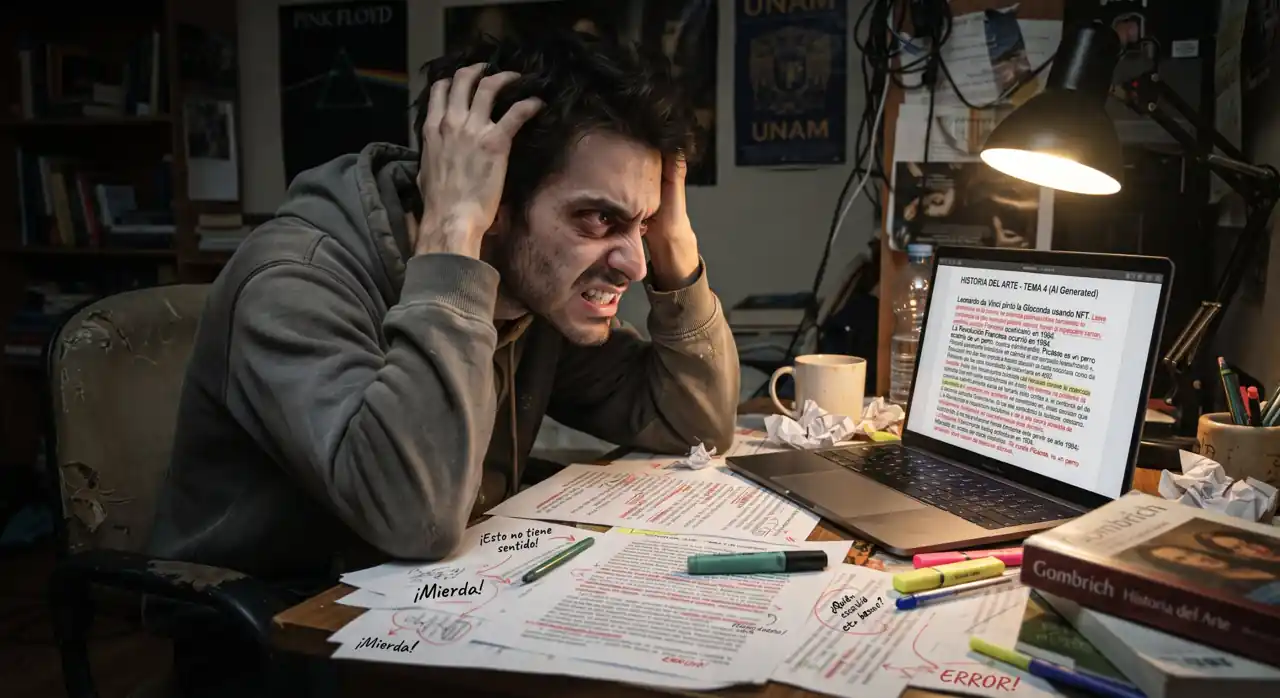
There is something profoundly hypnotic about artificial intelligence. You ask it a complex question, it answers within a couple of seconds with an invisible smile, uses perfectly structured paragraphs, puts bold text, and speaks in a tone so polite and self‑assured that it is almost impossible to doubt it. For a university student drowning in notes or a civil‑service candidate staking the job of a lifetime after years in the library, a chatbot seems like the holy grail: a private tutor available at three in the morning who never loses patience.
The problem is that this digital teacher has a colossal flaw: it suffers from a dangerous mix of pedantry and mythomania. In plain English, what we euphemistically call “hallucinations” is nothing more than monumental lies told with such conviction they would make the biggest con artist in the neighborhood blush.
For months we have been sold the idea that the great machines know everything. And it is true that they process titanic volumes of information. But they do not reason like a human being; they calculate statistical probabilities of which word should follow another. If they don’t have the exact data, instead of raising a hand and saying “I don’t know,” they prefer to fabricate it impeccably. And that is where the real trap for students begins.
Imagine a civil‑service candidate memorizing a legal article subtly altered by an AI, or a university student relying on a mathematical proof that looks brilliant but falls apart at the final step. The human brain, especially when under the stress of an exam, tends to look for shortcuts and to trust the authority of the screen. Studying with an unattended AI is like reviewing with a classmate who is an absolute genius in oration but makes up half of the syllabus the night before the exam.
The risks are not minor. In academia, getting used to the false comfort of the easy answer atrophies the most important muscle of the student: the ability to doubt, to contrast primary sources, and to investigate the why of things. An undetected incorrect answer can mean failing a call for applications or, worse, integrating a wrong concept that later becomes very hard to unlearn.
Artificial intelligence is a fantastic tool for structuring curricula, summarizing dense texts, or proposing study outlines, as long as it is used with the same healthy skepticism with which we would look at borrowed notes from a stranger. Real knowledge —the kind that truly settles in the head and does not evaporate when you leave the classroom— still demands effort, contrast, and personal judgment. The machine can give you the finished text, but the effort of checking whether it is true belongs to you. And in an exam, that difference is what separates a pass from a fail.
By Fernando Pérez